How to remember where you put things
The reliable way to remember where you put something is to record the place at the moment you put it there, in a form you can search later. Memory alone fails because putting things away is usually automatic, and we rarely form a clear memory of automatic actions. Everything below is a way of making that one moment count.
Why we forget where we put things
You put the passport “somewhere safe” while thinking about the trip, the kids or the phone call. The hand did the work; the mind was elsewhere. Later there is nothing to recall, because nothing was really noticed. The same happens with chargers, spare keys, warranty papers and the gift you bought early.
It gets worse with the things you hide on purpose. A “safe place” is, by design, not where you would look. So the better you hid it, the harder it is to find.
A safe place is, by design, not where you would look.
Six habits that work
None of them needs an app. Together they turn the automatic moment into a deliberate one.
Give every important thing one home.
Keys on the hook, passport in one drawer, chargers in one box. A thing with a home is rarely lost. The trick is to keep the list of homes short enough to remember.
Say it out loud as you put it down.
“My passport is in the bedroom drawer.” Saying it turns an automatic action into a deliberate one, and that is the moment you later need. It feels silly for a week and then it does not.
Write the place down where you will actually look.
A note on the fridge, a page in a notebook, a notes app, or an app made for this. The medium matters less than one rule: you must search there first, before you start opening drawers.
Take a photo of the drawer or box.
One picture of the open drawer shows you what is in it without opening it, and it settles the “did I really put it there?” doubt.
Keep a “safe places” list.
For the few things you hide on purpose, such as a passport, documents or a spare key, keep a short list of where. Update it when you move something. This is the list that saves you an hour before a flight.
Make the trip list the night before, with the place of each item.
Not just “passport, charger, laptop” but “passport (bedroom drawer), charger (office drawer), laptop bag (hall closet)”. In the morning you collect, you do not search.
Which tool fits which problem
Pen and paper
Works for a short list of safe places. Does not work for things that move, and cannot be asked.
A notes app
Fine if you are disciplined about writing and searching. It will not answer “where is my passport?”; you search and read.
A Bluetooth tracker
The right tool for keys, wallets and bags that leave the house. It rings and shows a map. It needs a tag on each item and usually an account.
A home inventory app
For hundreds of items in boxes and storage, with photos and labels. More setup, more power.
KnowWhere
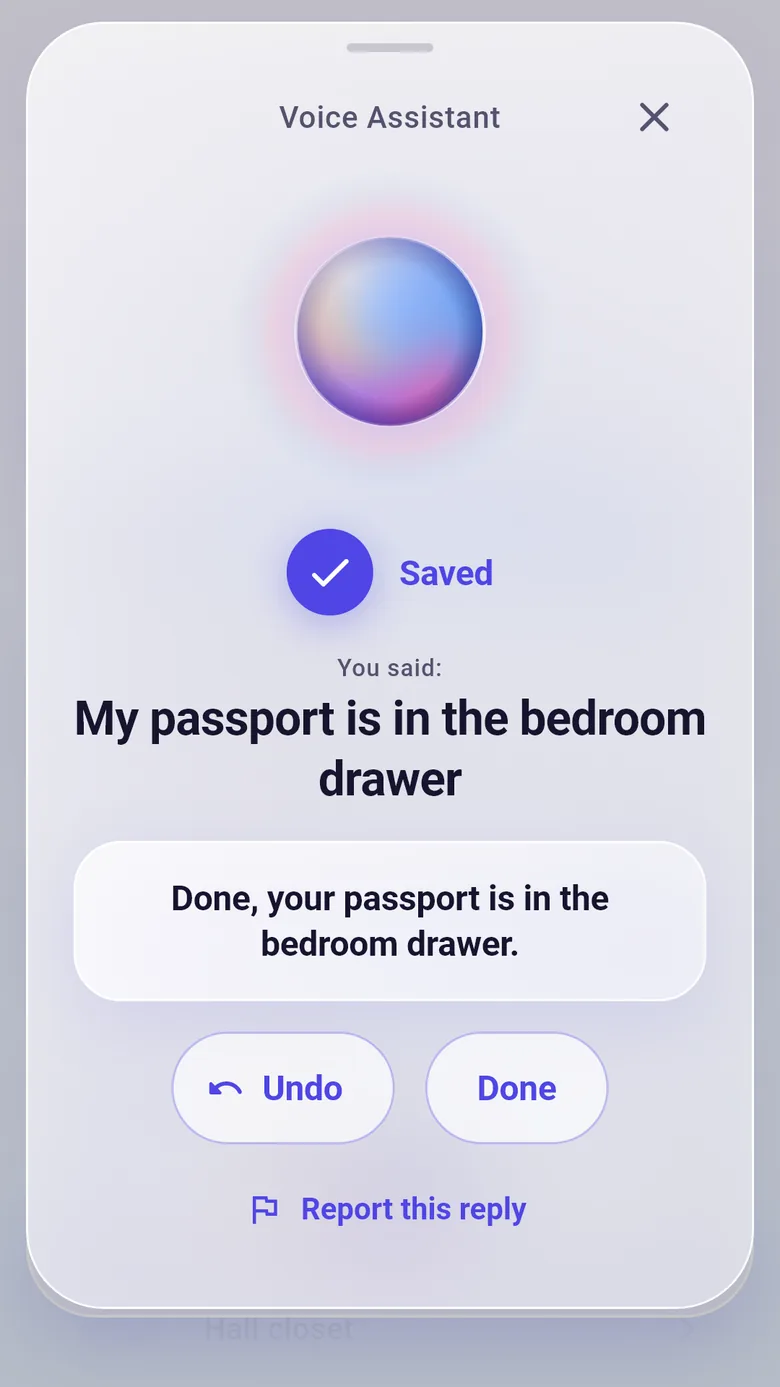
Does habits two and three in one step: you say “my passport is in the bedroom drawer” and it is saved; later you ask and it answers by voice, with the earlier places if you moved it, and it can remind you what to take and where it is. It works in English, Hindi and Urdu, with no account. It is Android only, and it only knows what you told it.
The full comparison, including when KnowWhere is not the right choiceHow KnowWhere fits in
KnowWhere was built for the moment in habit two. Saying the sentence is the whole job; nothing to type, no form, no folder. Ask later, in the language you spoke, and hear a short answer. The trip list in habit six is one sentence too: “remind me tomorrow morning to take my passport, charger and laptop,” and the reminder lists each item with where it is right now.
Two honest limits. It cannot find something you never told it about, and it does not track or ring anything. And replies come from an AI, so check anything that matters.
Questions people ask
Short answers, with the honest “it depends” where it applies.
What is the best app to remember where I put things?
It depends on what you lose. For keys and bags that leave the house, a Bluetooth tracker. For hundreds of items in storage, a home inventory app. For the handful of things you put away at home and forget, and you want to ask by voice in English, Hindi or Urdu without an account, KnowWhere. For everything else, the notes app you already have.
How do I keep track of my belongings at home?
Give each important thing one home, record the place at the moment you put it down (say it, write it or photograph it), and keep a short list of the places you hide things on purpose. Search the list before you search the house.
Is there a free app that remembers where I put things?
Yes. KnowWhere is free on Android, with no ads, no account and no in-app purchases. Notes apps are free too, if you prefer typing and searching to asking.
Why do I keep losing things?
Mostly because putting things down is automatic, and you were thinking about something else at the time. It is normal, and it is not a memory problem in itself. The fix is to make the moment deliberate, with any of the habits above.