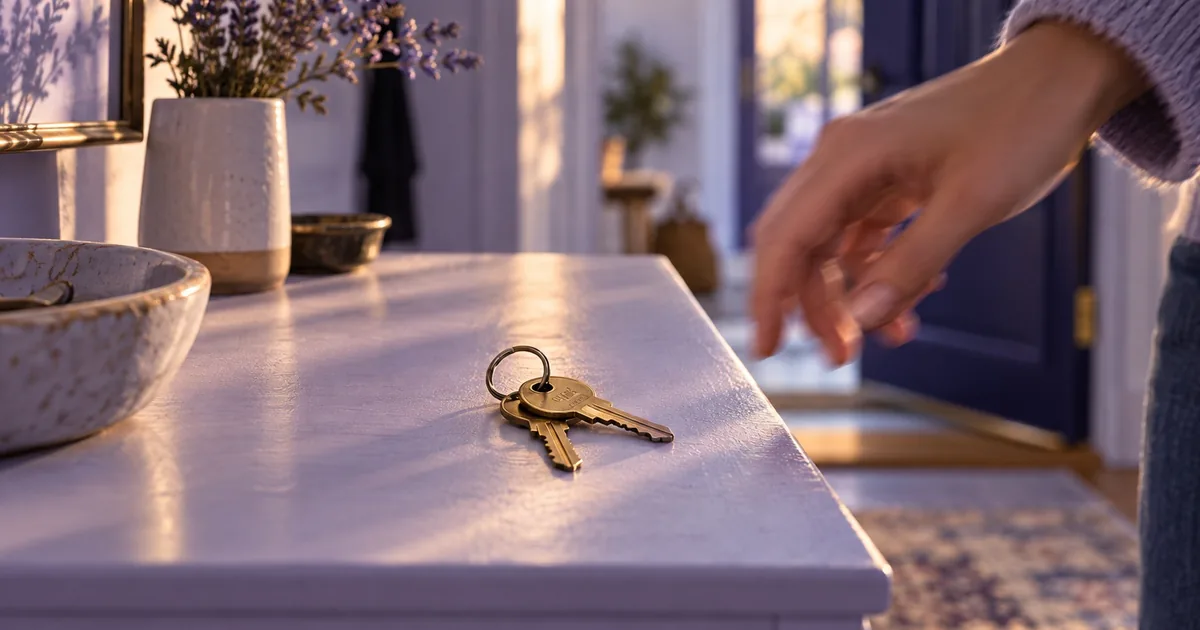
Often, forgetting where you put something is an attention slip, not a faulty memory. When you set the item down, your mind may have been elsewhere, so the spot was never stored well.
That's how keys end up in a coat pocket and a passport in a drawer you don't remember choosing. Health groups describe occasional misplacing as normal. This article explains what happens and what makes it worse. It also covers which signs are worth mentioning to a doctor, and three small habits that help.
If you are searching for something right now, start with the find-it-now steps in our guide, then come back for the why.
Short answer
- Misplacing things is often an attention slip when you put the item down, not a broken memory. This comes from memory research and has not been tested directly for misplacing.
- Tiredness, stress, poor sleep and some medicines are listed as causes of forgetfulness. Doing two things at once may add to it.
- Health groups call occasional misplaced keys normal. Lapses that disrupt daily life, or a clear change from your own past, are worth raising with a doctor.
- Experts recommend a fixed home for each item, doing one thing at a time, and saying the spot aloud. None is proven for misplacing.
This article is general information, not medical advice.
What happens when you put something down?
Your brain has to record the spot at the moment you put the item down. If your attention is elsewhere, that record is weak. Harvard Health describes absent-mindedness as forgetting because you didn't pay close attention. It uses psychologist Daniel Schacter's framework of normal memory slips. Its example is a pen you never focused on putting down. The information was never stored securely.
Picture coming home with a bag in one hand and a message on your phone. The keys go into a coat pocket while you read. In that picture, the weak step is the first one: the spot was never stored.
Others say something similar. Behavioral neurologist Glen Finney of Geisinger says what feels like a memory problem is often an attention problem. Lydia Cho of McLean Hospital is quoted by Harvard Health (2022). She says we often forget routine behaviors because we aren't fully engaged. In this article's view, putting keys down is a routine act.
A lab study adds indirect support. In a 1996 experiment by Craik and colleagues, dividing attention while learning cut later memory a lot. Dividing attention while recalling hurt little or nothing. Volunteers learned words, not where objects were. So it only hints that the moment of storing matters most.
Attention is also not the whole story. Psychologists Schacter and Mark McDaniel are quoted by Euronews and AP (January 2026). They say forgetting where you put things can happen when storing, keeping or retrieving the memory. No study found for this article measures directly why healthy adults misplace things at home. The attention explanation is an inference from memory research.
Why does it get worse when life is busy?
Tiredness, stress and poor sleep are on the usual lists of causes of forgetfulness. The NHS page on memory loss (checked 22 October 2026) names stress, anxiety, depression and sleeping problems. It says these are common, treatable causes.
A 2015 Harvard Health page lists seven causes: fatigue, medicines, poor sleep, lack of exercise, stress or anxiety, depression and alcohol. The medicines it names include sedating drugs, some antidepressants, urinary medicines and over-the-counter sleep aids. If you suspect a medicine, ask a doctor. Mayo Clinic Health System adds that some combinations of medicines can cause forgetfulness. It also says poor sleep, including sleep apnea, can be treated.
Doing two things at once matters too. The Association for Psychological Science released a 2012 summary of R. Key Dismukes's work for NASA. It found that interruptions, multitasking and being absorbed in something else cause people to forget what they meant to do. His examples were mostly from workplaces and aviation, and they were about remembering to act, not finding objects. A phone call while you put the keys down may be a small version of the same thing.
What does misplacing things mean?
To misplace something is to put it somewhere and then forget where. Wiktionary defines it as putting something somewhere and then forgetting its location, the same as to mislay. A misplaced item is usually close by, in a spot you chose without noticing. That is why this article treats misplacing mainly as an attention slip rather than lost memory.
What does "often forget to put things back in their proper place" mean?
You may have met this line in a personality quiz. "Often forget to put things back in their proper place" is one of four conscientiousness items in the Mini-IPIP, a short Big Five personality questionnaire published by Donnellan and colleagues in 2006. It is scored in reverse, together with "Make a mess of things". The other two items are "Get chores done right away" and "Like order". Agreeing with it counts toward a less orderly style.
In that quiz it describes a general habit, not a memory problem, and agreeing with it diagnoses nothing. In this article's view, the link to misplacing is practical: an item that has no fixed home, or never goes back to it, leaves you nowhere obvious to look. The fixed-home habit below is aimed at exactly that.
Things you put somewhere safe months ago
Picture a passport slipped into a "safe" drawer in spring and needed for a trip in autumn. In this article's view, the long gap makes this the hardest case, because months pass between putting it away and needing it. Schacter and McDaniel's advice in the Euronews and AP piece is to say aloud where you put things you rarely use.
A 2026 plan for a research review in the journal Gerontology says misplacing everyday items at home is common. It adds that searching for rarely used items is time-consuming and stressful. It reports no figures.
No study found for this article measures the long-gap case directly, so what follows is an inference. A spot that was stored weakly and never used again may get no chance to be refreshed. A "safe" place may also sit outside your normal routine, so nothing prompts you to look there. That's why the advice is to record the place at the moment you choose it. If it is a passport you can't find right now, our article on where to look for a passport at home gives a search order.
What is usual, and what is worth mentioning to a doctor?
Health groups separate occasional misplacing from other patterns. The Alzheimer Society of Canada says difficulty remembering where you left your keys is not a sign of dementia. Most of the time, it says, there is no cause for concern. Its warning signs page says anyone can temporarily misplace a wallet or keys. A person living with dementia may put things in inappropriate places.
Mayo Clinic Health System says misplacing a phone or car keys can be normal. It is irritating but manageable, and it doesn't disrupt work, independent living or social life.
Two questions help you judge the pattern. Howard LeWine, MD, wrote for Harvard Health in March 2026. He suggests asking how often it happens, such as several times a week or once or twice a month. He also suggests asking whether it's worse than 5 or 10 years ago. Euronews and AP also quote experts advising a doctor visit if losing things clearly increases compared with your recent past.
Consider speaking to a doctor if:
- Losing things is clearly more frequent than it used to be, or worse than 5 or 10 years ago (Harvard Health).
- Memory problems affect day-to-day life (NHS, Harvard Health). Mayo Clinic Health System gives work, independent living and social life as examples.
- You put things in places that make no sense for them (Alzheimer Society of Canada).
- Other people have noticed a change (Alzheimer Society of Canada).
- You also find familiar tasks hard, struggle to follow conversations or find words, or feel confused about time and place (NHS).
- You also have sudden headaches, blurred vision or weakness, which WebMD, a consumer health publisher, says need prompt medical care.
The NHS says to see a GP if memory problems affect day-to-day life, and not to try to self-diagnose. Treatment may work better if started early, and it helps to take someone who can describe the problems. The NHS also says dementia is not a normal part of aging (page checked 22 October 2026). Only a qualified provider can confirm dementia after assessments, according to the Alzheimer Society of Canada.
The Alzheimer's Society in the UK adds a reassurance: becoming forgetful doesn't mean you have dementia. Memory loss can come from physical or mental health problems.
Could it be ADHD?
The NHS page on ADHD in adults (reviewed 19 March 2025) lists signs of being inattentive. One is losing things often, like your wallet, mobile or keys. It says these symptoms usually start before the age of 12. It advises making a GP appointment if symptoms affect your studies, work or relationships. One sign on a list is not a diagnosis, and this article can't tell you either way. Our article on ADHD and losing things goes into why it happens and what helps.
Three small things that help
No trial turned up in our search showing that any of these three stops people misplacing things. Each has some support, and the strength differs.
Give each item one fixed home
Keys, wallet and charger go in the same place every time. Three separate sources recommend this: Harvard Health (2014), MedlinePlus and the Alzheimer's Society (UK). MedlinePlus suggests one place for wallet and keys. The Alzheimer's Society suggests a large bowl somewhere obvious, in advice written for people living with memory problems and their families. This is "recommended by", not "proven".
One related lab result is about planning. In a 2001 study, older adults given an if-then plan were more than twice as likely to start an action themselves. That was about remembering to act, so applying it to objects is a stretch.
Pay attention for two seconds
Look at the spot as you put the item down. Harvard Health advises doing one thing at a time and slowing down when you put something away. The two-second figure is a practical suggestion, not a tested dose. The evidence is the attention research above, which is indirect.
Say it aloud
Say "keys, coat pocket" as you hang up your coat. Harvard Health's 2022 page suggests narrating what you do, and its 2014 page suggests saying where you put things.
In labs, words said aloud are remembered better than words read silently. A combined analysis of many studies by Fawcett in 2013 found a moderate effect. A 2012 study by Lin and MacLeod found a smaller benefit in older adults, but it was still there. Those studies used words in a lab. Nobody has tested saying it aloud for keys in a trial that turned up in our search. Think of it as expert advice backed by word studies.
| Habit | Who recommends it | Evidence for misplacing |
|---|---|---|
| One fixed home for each item | Harvard Health, MedlinePlus, Alzheimer's Society (UK) | Recommended by experts. No trial found. |
| Do one thing at a time when you put it down | Harvard Health | Expert advice. Lab work on attention is indirect. |
| Say the spot aloud | Harvard Health, Schacter and McDaniel | Expert advice. Lab studies used words only. |
For the other habits, see the guide on how to remember where you put things. To turn them into a routine, see how to stop losing things: 8 habits that stick.
If you would like a tool
KnowWhere is a free Android voice app: say where something is, then ask later. It works in English, Hindi and Urdu and needs no account. It is not a tracker, so it can't find a lost item for you. It only knows what you tell it.
It is available on Google Play. KnowWhere is made by Aatox, the publisher of this site. A notes app, a paper list or Google's Remembered items feature are other options. You can compare the options.
Questions people ask
What does it mean if I keep forgetting where I put things?
Often it means your attention was elsewhere when you put the item down, so the spot was never stored well. Stress, tiredness, poor sleep and some medicines can add to it. Harvard Health and the Alzheimer Society of Canada describe occasional misplacing as normal. If it is clearly increasing, or affecting daily life, mention it to a doctor.
Is forgetting where I put things dementia, or normal?
Occasionally misplacing keys is not a sign of dementia, says the Alzheimer Society of Canada. Putting things in odd places, plus trouble with familiar tasks that others notice, is different. A list can't tell you. The NHS advises seeing a GP if memory problems affect daily life, and not trying to self-diagnose.
How do I remember where I put something months ago?
Say aloud where you put it as you put it away. Psychologists Schacter and McDaniel advise this for rarely used things. Keep that item in one regular spot. Write the place down if it is important, such as a passport. Harvard Health and MedlinePlus both suggest notes and lists. No study we found tested these steps for long gaps, so they are advice, not proof.
What does misplacing things mean?
It means putting something somewhere and then forgetting where. The item is usually nearby, in a spot you chose while your attention was elsewhere. Occasional misplacing is common and, according to the Alzheimer Society of Canada, not a sign of dementia on its own.
What does "often forget to put things back in their proper place" mean?
It is a statement from the Mini-IPIP, a short personality questionnaire. Agreeing with it scores toward lower conscientiousness, meaning a less orderly style. It is not a memory test and it diagnoses nothing. If it describes you, giving each item one fixed home is the most direct fix.
Why am I forgetful at 25?
None of the sources used here gives an age-specific answer. The NHS lists stress, anxiety, depression and sleeping problems as common, treatable causes of memory problems. Harvard Health adds tiredness and some medicines. A busy mind when you put things down may be another cause, but that is this article's own inference.
If it keeps getting worse or affects daily life, the NHS and Harvard Health advise speaking to a doctor. The warning list above also covers sudden symptoms.
Sources
Retrieved 22 October 2026, except the last two, retrieved 12 November 2026. Dates are those shown on each page. Where a page shows none, it is marked undated.
- Harvard Health, page on seven types of normal memory problems (12 Feb 2021): Harvard Health. Same upstream source: Flaws of normal memory (25 Jan 2018).
- Craik, Govoni, Naveh-Benjamin and Anderson, Journal of Experimental Psychology: General, study on divided attention and memory (1996): PubMed.
- Harvard Health, page on managing memory slip-ups, with Lydia Cho (2022): Harvard Health.
- Geisinger, article on when to be concerned about forgetfulness, with Glen Finney (page shows 24 Jun 2025): Geisinger.
- Euronews and AP, article on tricks for remembering where you put things (31 Jan 2026): Euronews and AP.
- NHS, memory loss page (checked 22 October 2026; the page is past its own review date): NHS.
- NHS, early symptoms of dementia (checked 22 October 2026; past its own review date): NHS.
- Harvard Health, page on seven common causes of forgetfulness (2015): Harvard Health.
- Mayo Clinic Health System, when to seek help for memory loss (2 Dec 2022): Mayo Clinic Health System.
- Association for Psychological Science, news release on failures of prospective memory, R. Key Dismukes (31 Jul 2012): Association for Psychological Science.
- Ye, McDonough, Chui and Mihailidis, Gerontology, review protocol (13 Mar 2026): PubMed Central.
- Alzheimer Society of Canada, differences between normal aging and dementia (undated): Alzheimer Society of Canada.
- Alzheimer Society of Canada, 10 warning signs of dementia (undated): Alzheimer Society of Canada.
- Harvard Health, Howard LeWine, MD, on occasional forgetfulness and aging (9 Mar 2026): Harvard Health.
- Alzheimer's Society (UK), worried about memory problems (undated): Alzheimer's Society.
- WebMD, a consumer health publisher, adult ADHD and memory loss page, used for urgent symptoms (reviewed 14 Sep 2024): WebMD.
- NHS, ADHD in adults (reviewed 19 Mar 2025): NHS.
- Harvard Health, tips to improve your memory when you can't find things (13 Aug 2014): Harvard Health.
- MedlinePlus (NIH), remembering tips (reviewed 27 Oct 2024): MedlinePlus.
- Alzheimer's Society (UK), coping with memory loss (undated): Alzheimer's Society.
- Chasteen, Park and Schwarz, Psychological Science, study on if-then plans in older adults (2001, abstract): PubMed.
- Harvard Health, how to get more from your memory (2012): Harvard Health.
- Fawcett, meta-analysis of the production effect (2013): PubMed.
- Lin and MacLeod, study of the production effect in older adults (2012): PubMed.
- Wiktionary, entry for "misplace" (retrieved 12 November 2026): Wiktionary.
- International Personality Item Pool, items in the Mini-IPIP, citing Donnellan, Oswald, Baird and Lucas, Psychological Assessment 18, 192–203 (2006) (retrieved 12 November 2026): IPIP.
This article is general information, not medical advice.
Aatox wrote this article with AI assistance and checked each claim against the sources listed above. A clinician has not reviewed it.
Last checked 22 October 2026; the section on misplacing and the Mini-IPIP was added 12 November 2026. Published by Aatox, a small independent maker of everyday tools. Read more about Aatox or contact us.